

Amazon disclosed in its Q1 earnings call that nearly 20% of shoppers who interact with a sponsored brand prompt in Rufus continue the conversation about that brand – one of the first concrete data points any major platform has published on advertising performance inside an AI shopping interface. The disclosure lands as ChatGPT completes its pivot toward the same monetization model Amazon has been building.
McKinsey and ICSC forecast U.S. agentic commerce will reach $1 trillion by 2030, citing 68% of consumers using at least one AI tool for shopping in the past three months. Six months ago, there was a genuine divergence in how that activity might be monetized: ChatGPT’s 4% transaction fee through Instant Checkout looked like an organic-discovery alternative to a model where seller visibility on Amazon increasingly depends on ad spend. That alternative is gone.
OpenAI launched advertising in ChatGPT in February to a select group of U.S. advertisers, abandoned Instant Checkout in March citing execution challenges, and this week opened its ads manager to all U.S. advertisers while dropping its $50,000 minimum spend. Today’s Rufus and ChatGPT shopping experiences sit at the assisted-discovery end of agentic commerce – sponsored prompts and conversational recommendations rather than agents independently executing purchases. The autonomous-transaction layer is still under construction, but the monetization model for the surrounding discovery surface is being decided now.
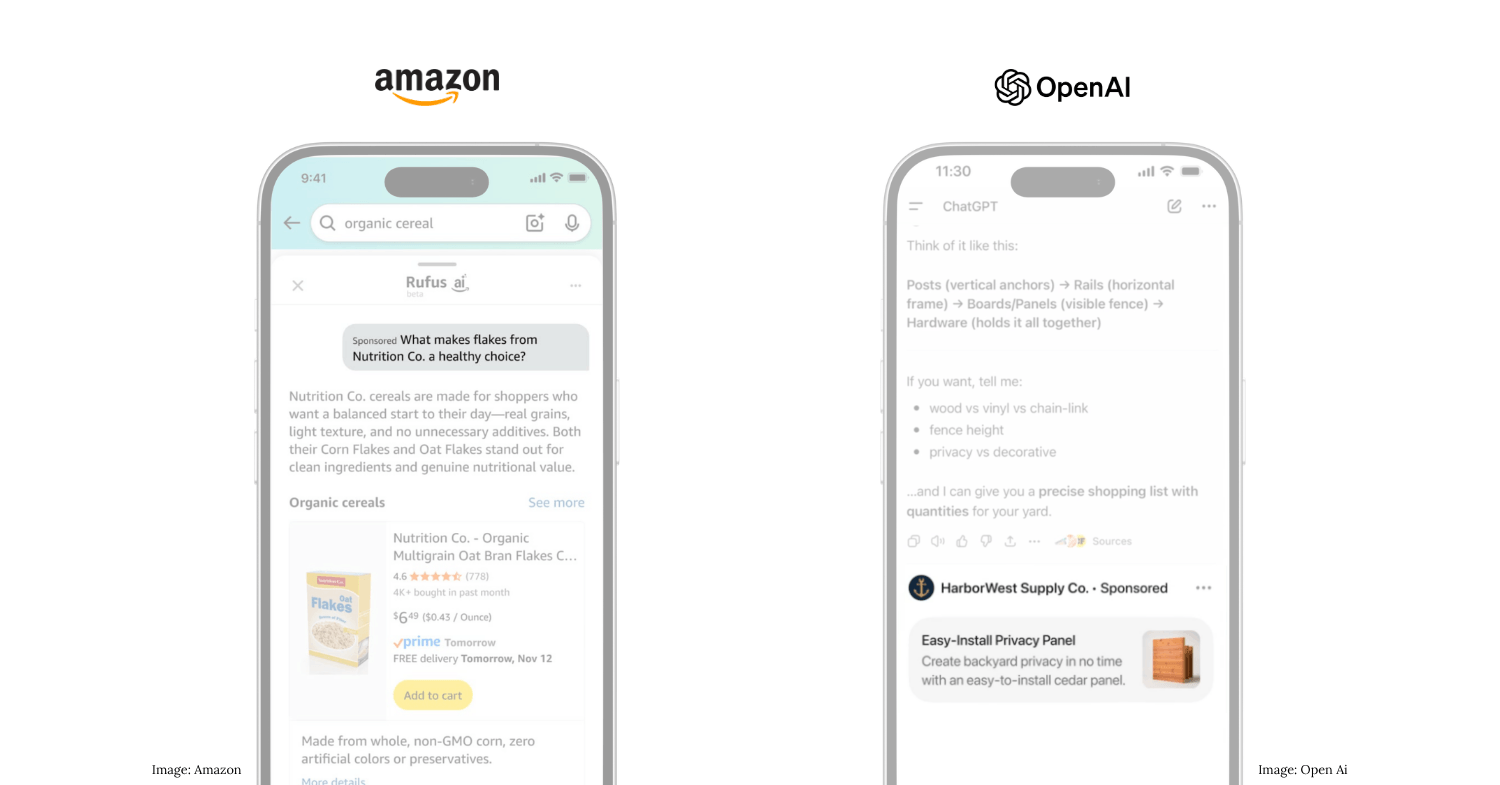
Amazon’s existing infrastructure makes the convergence look one-sided. Advertising revenue grew 22% on a constant-currency basis in Q1 on a $70 billion-plus TTM base, continuing a multi-year pattern of ads outpacing total Amazon revenue growth. Rufus monthly active users were up 115% year over year and engagement was up nearly 400%, with the assistant driving an estimated $12 billion in incremental sales. Sponsored Products and Brand Prompts launched on that surface this quarter. The “nearly 20%” figure – Amazon CEO Andy Jassy explicitly caveated that “it is early” – measures whether shoppers continue a brand conversation, not whether they buy.
Shopify’s response reflects a long-running strategic posture rather than a new direction. The company has resisted competing for consumer attention since at least 2021, when President Harley Finkelstein said “we have no plans to be a marketplace” – even as Shopify added marketplace functionality into the Shop app, including universal search and a web-based catalog. This week, Shopify launched connector apps for ChatGPT and Claude that let merchants manage their stores inside whichever AI agent they prefer, citing internal data that 83% of its merchants already use ChatGPT. The “arming the rebels” posture continues: Shopify is again choosing to embed merchants inside whoever wins the consumer surface rather than build an alternative to it.
For sellers, the convergence eliminates the most plausible non-ad path to scale in agentic commerce. Amazon’s record advertising revenue is being generated against a smaller active seller base than a year ago, per Marketplace Pulse research, and ChatGPT’s original 4% model – which offered broad merchant access without ads as the primary discovery mechanism – no longer exists in its original form. With Instant Checkout shelved, OpenAI’s ads manager open to every U.S. advertiser, and Shopify continuing its long-standing decision not to compete for consumer attention, agentic commerce is settling into an ad-supported model. Amazon is currently alone with both the audience at scale and the disclosed data to show what that model looks like in practice.


