

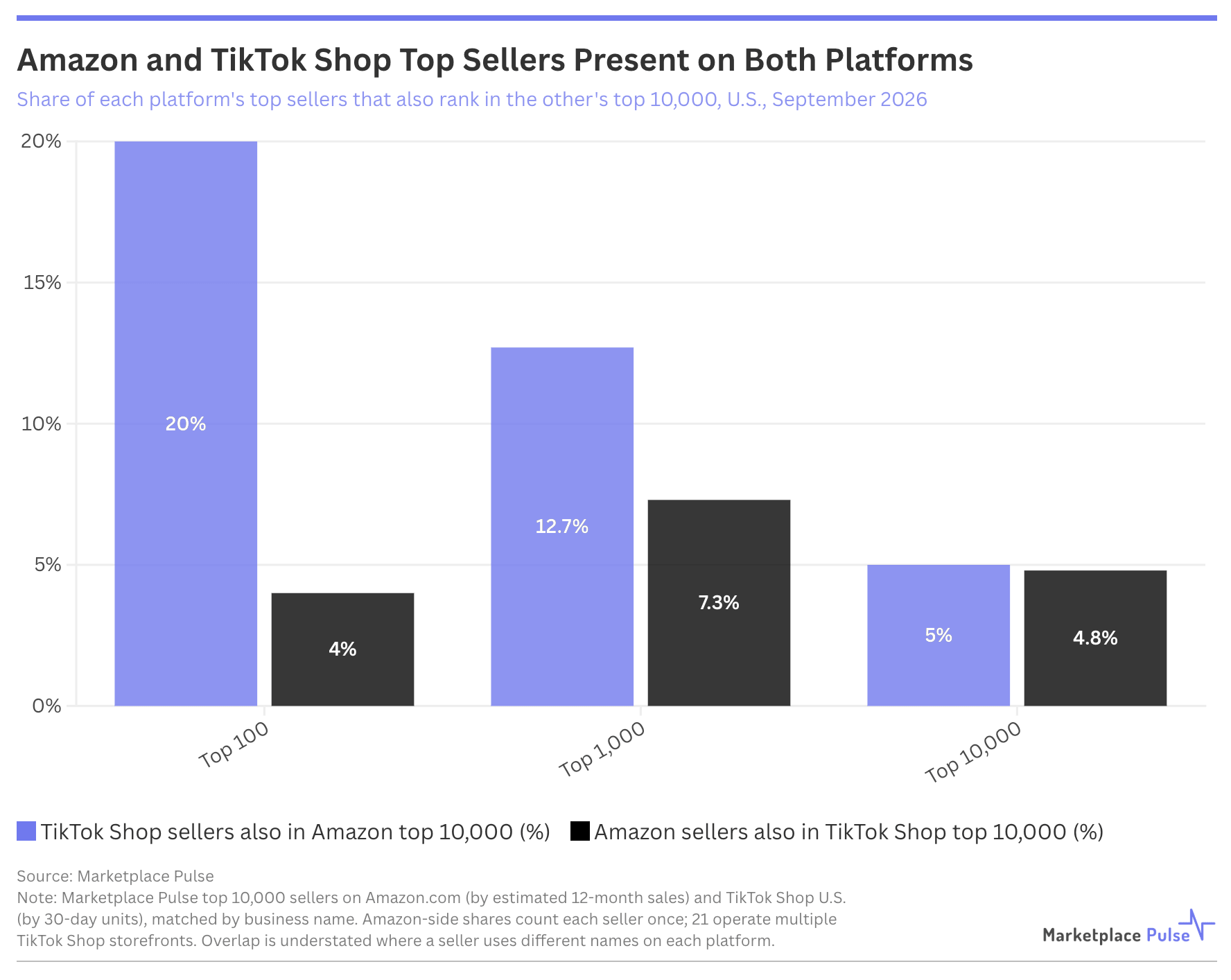
One in five of TikTok Shop’s hundred largest U.S. sellers also ranks among the top 10,000 sellers on Amazon.com. One in twenty-five of Amazon’s hundred largest ranks among the top 10,000 on TikTok Shop. A brand that succeeds on TikTok is five times more likely to also succeed on Amazon than the other way around. That ratio is the clearest evidence yet that the two platforms are not two versions of the same business, and that the road between them is far steeper in one direction than the other.
Marketplace Pulse matched its list of the 10,000 largest sellers on each platform by business name. Only 498 appear on both, about 5% of either list. Among those 498, a seller’s rank on Amazon has almost no relationship to its rank on TikTok. Being big on one says nothing about being big on the other, because the two platforms reward different things, and only one of them hands its winners a head start on the other.
The difference is in what each platform is for. TikTok makes people want things. Amazon is where people buy things. Two decades of Prime have made Amazon the place American shoppers go to complete a purchase almost by reflex: the card is on file, the delivery date is promised, the returns are painless, and the reviews are trusted. When a shopper sees a product demonstrated in a TikTok video, many do not buy it there. They open Amazon, type the brand name, and buy it where they always buy.
This was true before TikTok Shop existed. In 2021, a pair of leggings became Amazon’s best-selling clothing item because TikTok videos that could not even link to a product page sent millions of users to search for it on Amazon. TikTok Shop added checkout, fulfillment, and a creator commission program to keep those sales inside the app, and many now stay. But the reflex is intact, and a brand that wins the feed inherits an Amazon business it did not have to build.
No shopper who finds a product on Amazon goes to TikTok to buy it. Amazon spent years trying to become a place where people discover products rather than just buy them, and every attempt failed. Amazon Live could not hold a thousand viewers on a normal day. Inspire, its TikTok-style feed, launched in 2022 as a near-copy of a 2017 feature called Spark that had already gone nowhere, and was shut down in 2025 having been lost among the dozens of features in the Amazon app.
For a seller, the consequence is that little from an Amazon business transfers. Success on Amazon is search rank, review count, advertising budget, and inventory in Amazon’s warehouses. Success on TikTok is a product whose result can be demonstrated on camera in fifteen seconds, sold by a brand that treats content as its primary channel, promoted by thousands of creators earning a commission on each sale. Most of what sells well on Amazon fails that test. A replacement charging cable, a set of storage bins, a pack of printer paper: these are products people search for, not products anyone films. And where the product does fit, the seller enters a market that has already sorted itself. On TikTok Shop, 1% of sellers drive 60% of sales. Raw content is cheap to make and new creators appear every day, so the door is open. However, it leads into a room where the demand is already concentrated around brands that have been building creator relationships since launch.
The split is hardening, not blurring. TikTok has become the demand engine for a specific kind of product, worn, applied, or consumed, and Amazon has become the place that demand is settled, whether or not the sale started there. Amazon’s current answer, AI shopping assistants that reorganize a catalog, does not change that, because reorganizing a catalog is still a search-first idea.
For an existing Amazon seller, TikTok’s value is therefore best measured in Amazon branded searches, not TikTok Shop orders. If the product can be filmed, fund the creators and expect much of the return to land on Amazon. If it cannot, TikTok is not a channel, and no listing will make it one. The brands to watch are the ones that never had to make that choice. Increasingly, the next generation of consumer brands will launch on TikTok and mature on Amazon, and the sellers who built the other way around will find their Amazon rank buys them nothing in the social feed.


