

U.S. e-commerce grew 12.2% in the second quarter, its fastest in five years, and reached a record 17.1% of all retail spending. It was the second consecutive quarter of double-digit growth after four years without one, and a fourth consecutive record for share, which took five years to reclaim its pandemic peak. After a year in which online sales barely gained ground on stores, the shift to the internet has resumed.
That makes 2025 look less like the arrival of maturity and more like a pause. E-commerce grew around 5% a quarter through last year while physical retail held its usual pace. It read at the time as a market settling permanently into the 5-8% growth range. Shoppers never stopped spending during those quarters, though. They stopped moving online at the usual rate for about a year, in a window when tariffs and the end of the de minimis exemption hit the categories where online had been gaining fastest, and now they have resumed.
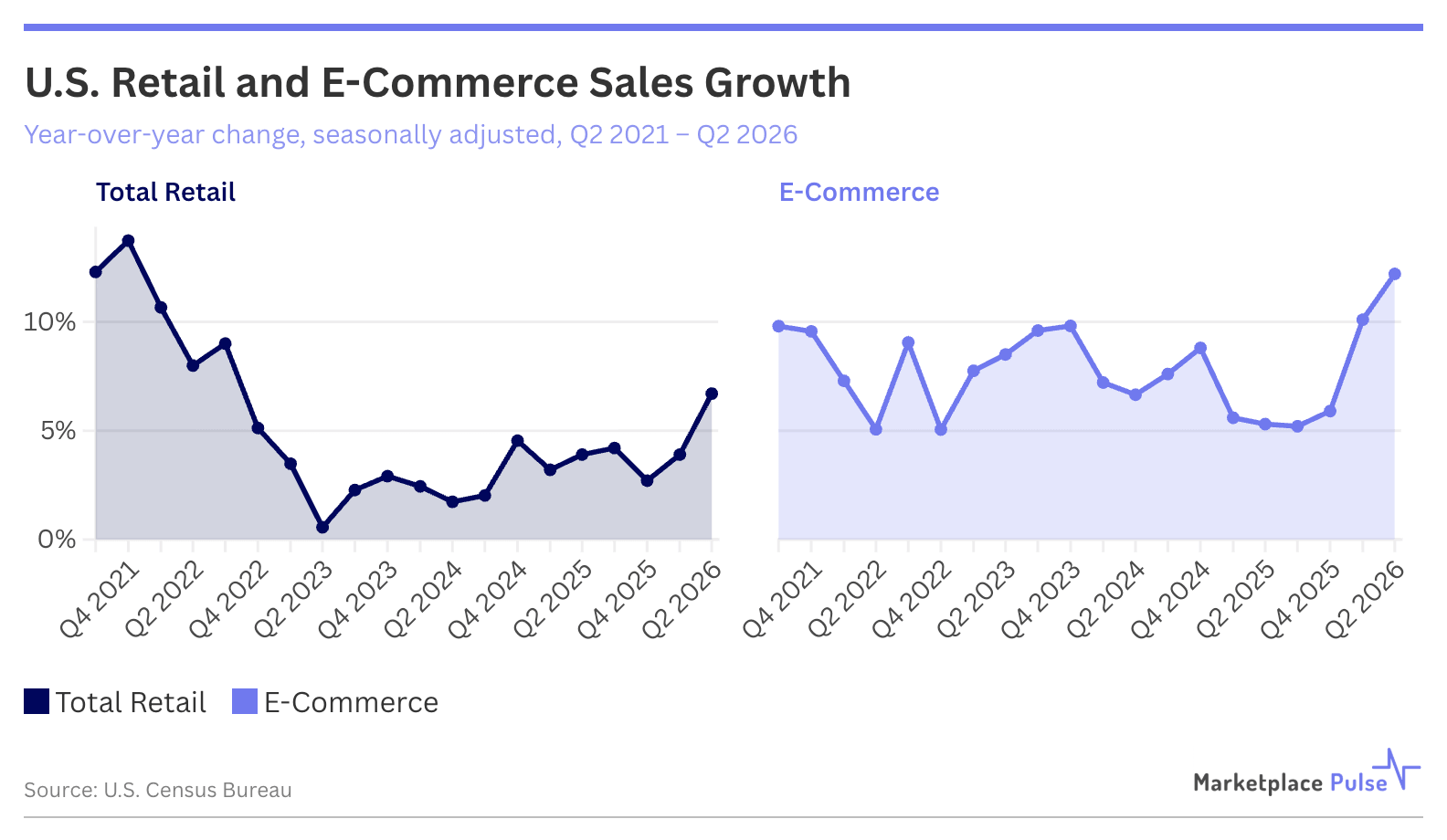
Prices flatter the recovery. Total retail grew 6.7%, its fastest since 2022, and when every part of retail speeds up at once, price is usually the reason rather than demand. Goods prices were flat or falling through 2024 and are rising now, which lifts sales figures without a single extra order being placed. Roughly a third of the recent acceleration is bigger price tags, leaving real growth near 8%, roughly where it ran in 2024. Set against a stagnant 2025, that is still the best market in three years. Set against 2024, it’s a recovery to the previous trajectory rather than a break above it.
The largest platforms are all growing faster than the market they sit in, some at double its rate. Walmart’s U.S. online sales rose 24% and its advertising business 38%, compared with 3.5% growth across its overall U.S. business. Shopify’s North American merchants sold 28% more. Amazon’s own online store sales grew 15%. Growth above the market rate must come from the rest of the market. Just as seller revenue keeps concentrating toward the top, so does platform revenue.
For sellers, the useful read is that demand has genuinely returned, and that the record 17.1% describes how large online has become rather than how fast it is still growing. It also understates the market sellers actually compete in, since it counts cars, gas, and restaurants as retail, none of which sell online in any real volume. The market is expanding again at the rate it managed in 2024, and most of what it adds is going to the platforms that were already the largest.


