

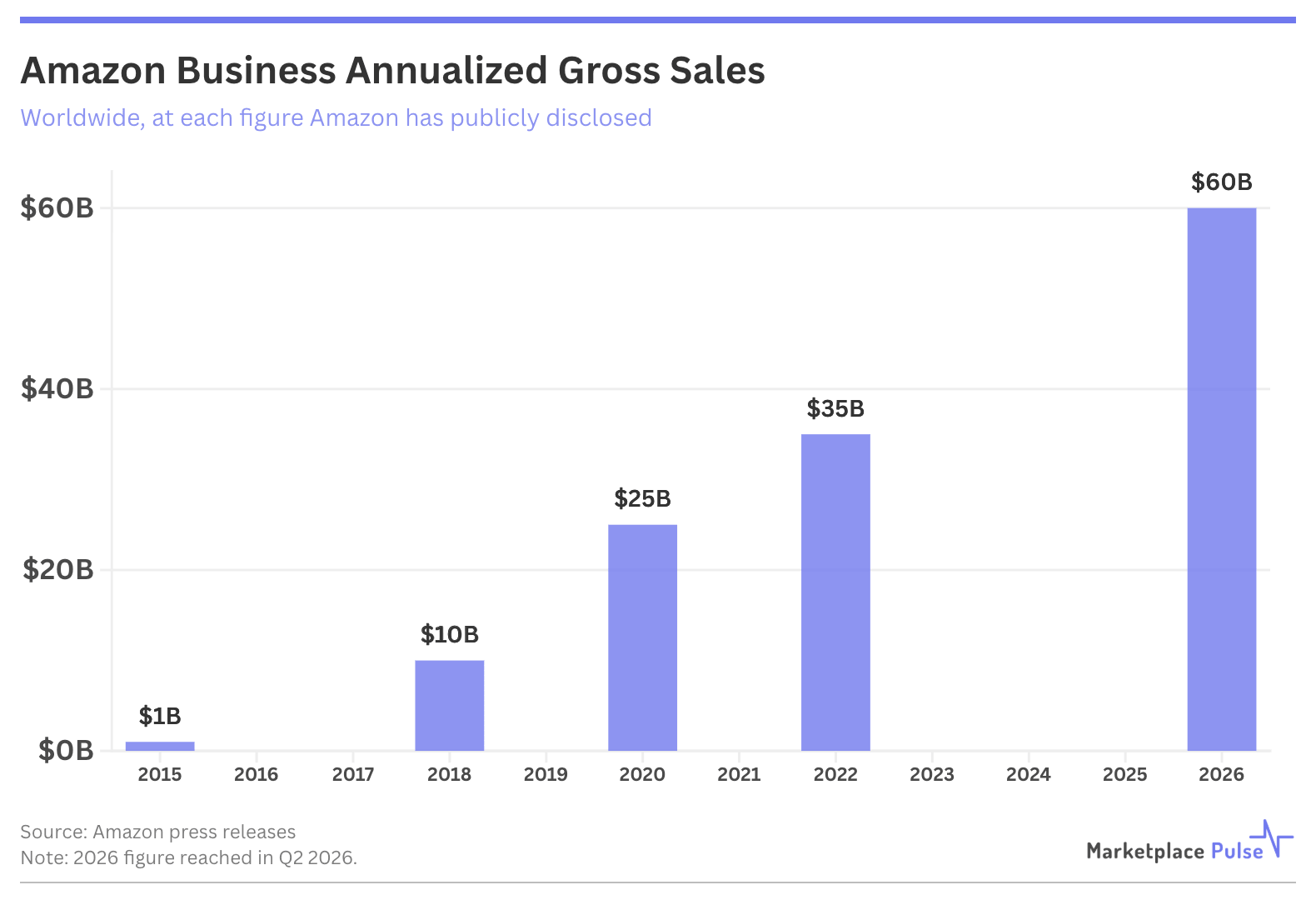
Amazon Business reached $60 billion in annualized gross sales, up from the $35 billion Amazon disclosed in 2023 and $25 billion in 2021. Amazon reports the figure globally across 11 countries, so it doesn’t map cleanly onto the U.S. marketplace rankings, but as a standalone business it would sit among the largest e-commerce marketplaces anywhere. It is also approaching the scale of Amazon’s advertising business, which generated $68.6 billion in 2025.
On Marketplace Pulse estimates, it represents roughly 7% of the $830 billion Amazon and its sellers sold last year, and if the historical split holds - Amazon has said more than half of Amazon Business sales come from third-party sellers, consistent with sellers accounting for an estimated 69% of total GMV - something in the region of $30 billion of it flows to sellers.
The growth is steady, yet more modest than once predicted. Amazon Business crossed $25 billion in 2021 in less than five years, less than half the time consumer sales took to reach the same figure - a pace that made $100 billion look achievable within another five years. Today it stands at $60 billion. The compounding has been almost perfectly consistent: roughly 18% annually from 2021 to 2023, and roughly 18% again from 2023 to today.
That outpaces the 9% Amazon’s overall GMV grew last year and the 5-8% baseline U.S. e-commerce has settled into as a mature market, but the early acceleration never returned. The reason is structural: business-to-business spending is multiples of consumer spending, yet far less of it has moved online. Procurement runs on approval chains, purchase orders, payment terms, tax exemption, and negotiated contract pricing - none of which the consumer marketplace solved on the way. Amazon has spent eleven years digitizing the least complex end of that market.
Almost everything Amazon announced alongside the milestone addresses buyers rather than supply. The company says it has introduced an assistant answering account questions, Savings Insights analyzing spend for bulk discount opportunities, and Spend Anomaly Monitoring flagging unusual purchases. It has begun rolling out dedicated delivery trucks across 13 states built for loading docks and mailrooms, and expanded Prime Business to bundle CrowdStrike, Gusto, and QuickBooks alongside Amazon Quick. These are procurement software problems. The supply side, meanwhile, runs on tools that have changed little: sellers enrolled in the B2B program set business-only pricing visible to verified buyers, tiered quantity discounts, business-only listings, and respond to custom quote requests - capabilities that have existed for years while the buyer experience was rebuilt around them.
That asymmetry is the opportunity. B2B demand arrives through listings sellers already maintain, at higher average order values, from customers that include hospitals, universities, governments, and 97 of the Fortune 100. Fewer than 8,000 sellers now generate half of Amazon’s estimated $300 billion in U.S. third-party GMV, and 49% of sellers name marketplace fees as their primary margin concern, with 46% citing advertising. Incremental demand captured through quantity discounts on existing inventory is a different proposition than incremental demand bought through an ad auction.
Amazon Business will not become the headline story of Amazon’s next decade at 18% a year, and it does not need to be. It is already a segment sized larger than most standalone e-commerce marketplaces, built on infrastructure Amazon had already paid for, serving customers with higher order values and stickier purchasing behavior than consumers. The pattern is familiar: Amazon behaves like a retailer while compounding adjacent businesses that scale on assets already in place. B2B is the least visible of them, and on the current trajectory, it reaches $100 billion before the end of the decade.


