

Ask Amazon’s AI assistant for its best recommendation, and it reaches well past the products search rank rewards, often into a part of the catalog most shoppers never scroll to.
In one of the first large-scale studies of what Alexa for Shopping recommends – 1,963 non-branded queries and 12,810 recommendations captured in May and June by Autopilotbrand.com, an AI-optimization vendor – 63.9% of its picks fell outside the organic top-10 for the matched search term, and 40.9% never appeared on the visible results page at all. Only 14.3% of picks were products running a sponsored listing on that search page, and 83% of those already ranked organically anyway.
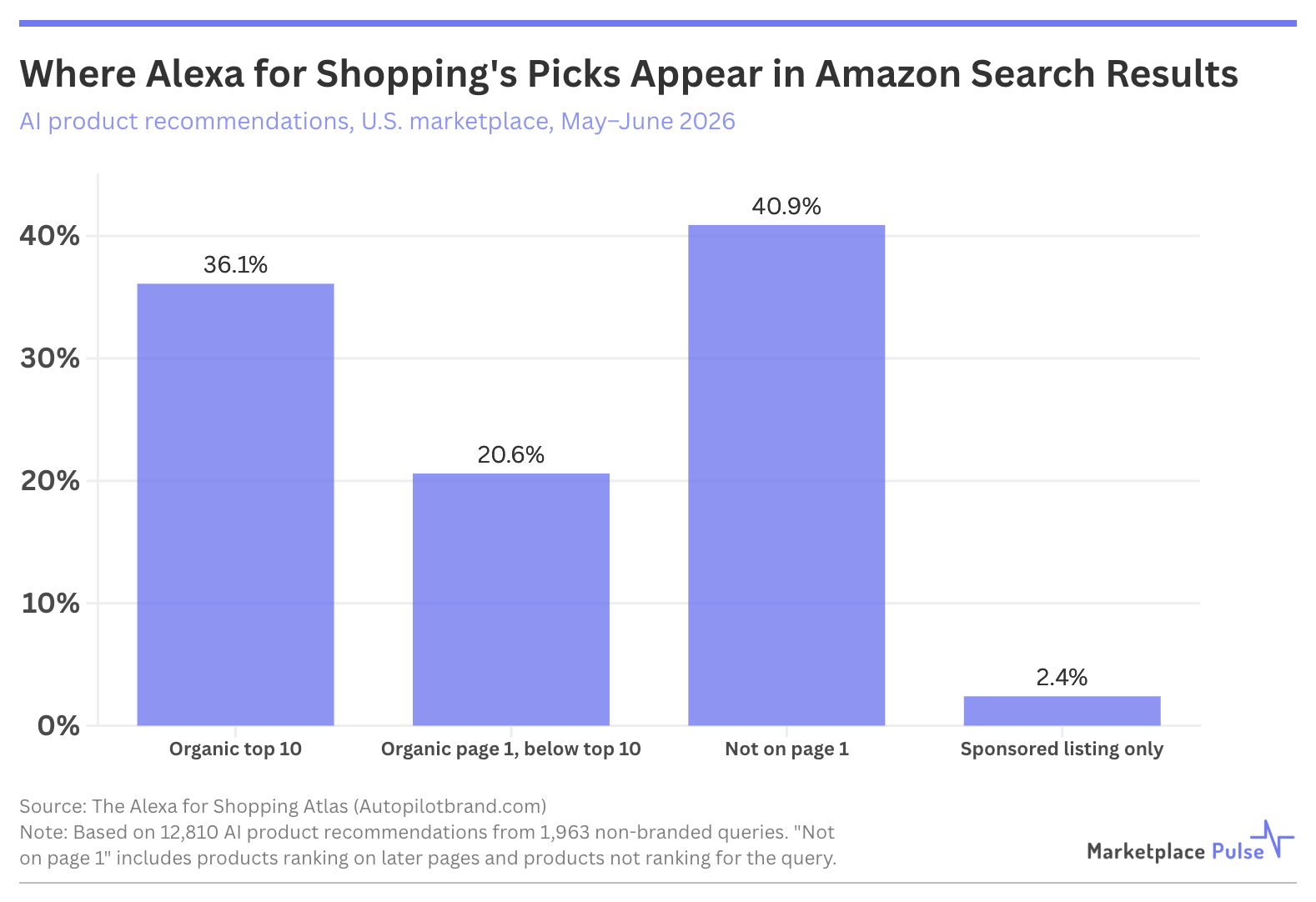
The study posed a best-of question to the assistant (“what is the best queen mattress?”) against the bare category search (“queen mattress”), so the gap measures something specific: asked to recommend rather than to list, the assistant surfaces a materially different, and often deeper, set of products than the search page most sellers optimize for.
Rank and ads are the two routes to visibility on search: the first earned slowly through the sales velocity that ad budgets are spent to manufacture, the second bought outright at auction. Neither appears to shape AI discovery yet, and rank is the sharper omission – the metric Amazon teams build dashboards around, and the one thing the assistant most conspicuously declines to follow.
The result builds on a thesis Marketplace Pulse has been tracking all year. In May – the same month Amazon renamed Rufus as Alexa for Shopping, folding the recommendation engine into a broader assistant – the agentic ad convergence appeared to be closing the last non-ad path to scale. Amazon launched Sponsored Products and Brand Prompts inside Rufus. ChatGPT abandoned its organic-checkout alternative. That monetization is advancing, but this study measures a different question – whether a product’s standing on the search page buys its way into the assistant’s answer. On the evidence, it does not.
It is also the shelf finally doing what it once couldn’t. Two years ago, the assistant merely returned links to searches shoppers could have run themselves, then grew more confident but not more intelligent. A two-thirds decoupling from search rank is the measure of a system that stopped reprinting its own results.
“We’re seeing the emergence of a third shelf alongside organic search and paid placements. Brands cannot simply buy or rank their way onto it; they need to give Amazon’s AI Alexa enough context to understand when and why their product is the right recommendation. That means richer catalog data, optimization around shopper intent, and continuous updates as seasonal use cases and product differentiators evolve. For products that do not yet own the top of search, this creates an entirely new path to compete.”
Christian Umbach, Co-Founder & CEO, Autopilotbrand.com
For sellers, the caution is that this is a single snapshot from one US account, captured early. On search, sellers paid $68.62 billion in 2025 as ads continued to crowd in around the organic results. The AI shelf is, for now, the rare surface where rank incumbency is a weaker moat and a product outside the search winners can appear where a category leader does not. Search looked like that once too, before the ad load found it. The AI shelf’s economics are not yet written. The sellers learning how it selects now are the ones who will notice the day that changes.


