

Walmart’s U.S. third-party marketplace grew nearly 50% year-over-year in the first quarter of fiscal 2027 (the quarter ending April 30, 2026), its fastest pace in years. On the company’s earnings call, CFO John David Rainey said third-party marketplace sales growth reached its highest level in two and a half years. For sellers, the signal is that Walmart’s marketplace is growing faster now than at almost any point since it opened to international sellers, and it is doing so from a base small enough that the runway remains long.
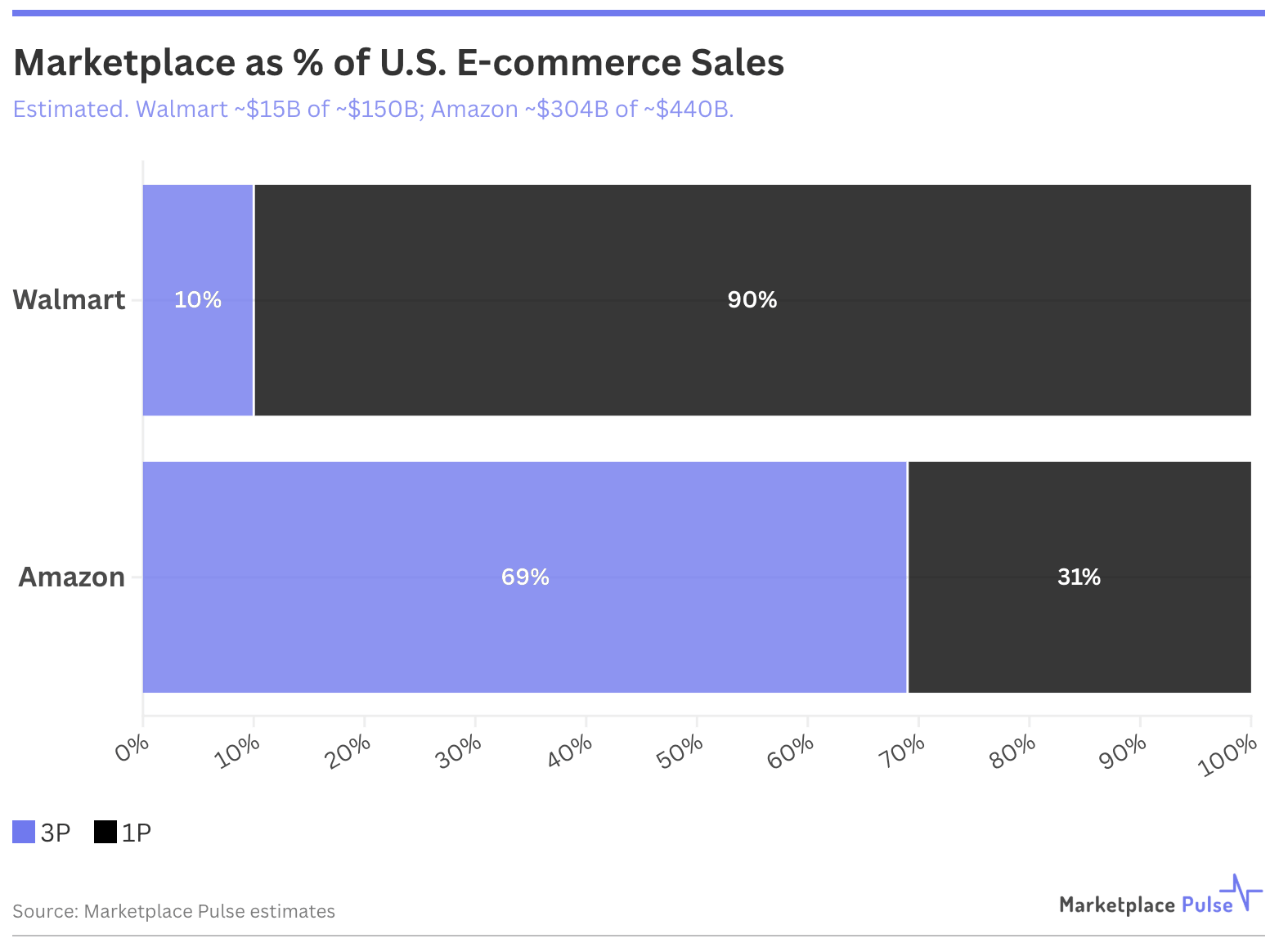
That base is the context the headline number needs. Walmart’s marketplace GMV is estimated at roughly $15 billion, around 10% of its $150 billion U.S. e-commerce business, compared to an estimated 69% of Amazon’s roughly $440 billion in U.S. GMV. Walmart’s marketplace business is accelerating precisely because it is early. The two platforms are also finding growth in different places: Amazon’s own retail business has clawed back unit share from sellers for two straight quarters, while Walmart’s growth is coming from the opposite direction, led by third-party sellers expanding its assortment.
That growth is being driven by the same seller-facing investments that have reshaped Walmart’s e-commerce economics. Its U.S. e-commerce operation, which lost more than $1 billion annually as recently as 2019, was profitable in every quarter of fiscal 2026, and the marketplace, carrying no inventory risk, is central to that turn. Units shipped same-day or next-day through Walmart Fulfillment Services grew nearly 150% in the quarter, and Walmart can now reach roughly 60% of U.S. households within 30 minutes. Rainey credited those speed investments directly for the marketplace’s momentum. WFS adoption has long shaped where listings appear in search results. Advertising completes the loop. Walmart Connect, the U.S. platform where sellers bid for placement, grew 44% excluding VIZIO, and third-party advertising spend rose more than 50% as sellers competed for visibility.
According to Marketplace Pulse data, Walmart has an estimated 200,000 active sellers on its marketplace, and it spent the quarter adding to that base in new ways, launching a cross-border marketplace into Canada and Mexico to extend its “build once, scale globally” platform logic outward. For sellers already on Walmart, that opens new geographies through existing infrastructure rather than simply inviting more competition into the U.S.
The marketplace is still a fraction of Amazon’s. But it is growing several times faster, getting more profitable, and integrating fulfillment, advertising, and delivery speed into a single ecosystem. For sellers, that combination is what turns a smaller marketplace into a more compelling one.


