

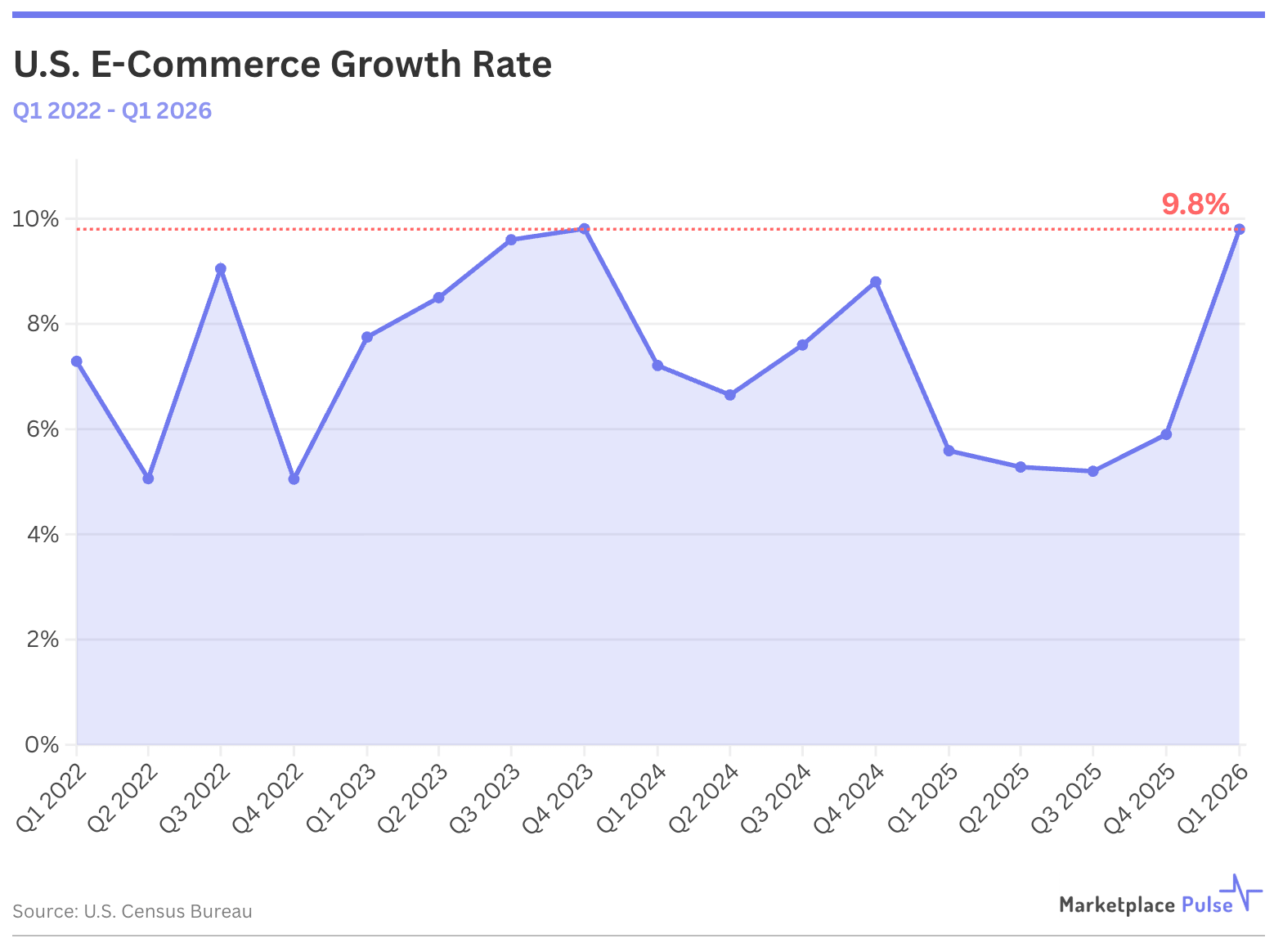
U.S. e-commerce grew 9.8% year over year in the first quarter of 2026, nearly double the rate posted in each of the prior four quarters. It was the strongest quarter in over two years, yet weaker than it sounds. Roughly half the acceleration was rising prices, not rising volume. Much of the remaining real growth was financed by a one-third surge in buy-now-pay-later borrowing. And at eBay and Etsy, two of the largest marketplaces that still disclose their customer counts, sales rose while the customer base did not.
The headline figure, from the Census Bureau, counts dollars, not items. Adjusted for price changes, the picture is smaller. Physical-goods prices, measured by the Federal Reserve’s preferred index, rose about 1.9% over the year, which puts real volume growth closer to 8%. That is still a genuine acceleration from the 5% range that held through 2025, when flat prices kept dollar and volume growth nearly identical. But close to half of what made this quarter look exceptional was higher price tags, not more goods sold. Tariffs are the obvious cause, though the Federal Reserve Bank of Minneapolis found the categories with the steepest price increases were often not those facing the steepest tariffs.
More revealing is who was doing the buying. eBay’s gross merchandise volume, the total value of goods sold across its platform, rose 18%, or 14% excluding currency swings. Its active buyer count rose about 1%, and excluding a recent acquisition, it was essentially flat. Etsy’s marketplace sales grew 5.5%, while its active buyer count remained below its level a year earlier. Both grew by selling more to the same people, not by adding new ones. That divergence is only visible because eBay and Etsy still publish buyer counts. Amazon and Walmart, both larger, do not.
That makes the acceleration hard to source. Amazon reported paid units up 15%, and Shopify reported merchant sales up 30% in currency-adjusted terms, but neither says whether new or existing customers produced it. The clearest evidence of genuine customer growth lies with the firms that lend shoppers the money. Affirm and Klarna, the two largest installment-payment providers, grew purchase volume on their networks by 33% to 35%, and their user bases by roughly a fifth. Affirm’s average purchase size fell, from $273 to $255, a sign shoppers are increasingly financing everyday items rather than occasional large ones. Much of the quarter’s real growth was bought on credit.
The growth eBay and Etsy reported came from existing buyers spending more, not from more buyers. How much of that is higher prices and how much is more goods is impossible to say from the outside — neither company discloses unit volumes — but several one-off factors clearly flattered the figures. Currency swings accounted for a meaningful share of eBay’s growth, which was lifted further by record collectible-card sales, including a single $16.5 million card. A rising price environment across e-commerce adds more, though by how much for these two platforms specifically cannot be known.
The quarter was not a bad one for the companies involved. More dollars from the same customers are still more dollars, and eBay and Etsy are more profitable for it. But as a gauge of e-commerce’s health, gross merchandise volume has become unreliable: inflated by price, and increasingly a measure of how much more existing customers spend rather than how many new ones a marketplace has won. Our maturation thesis holds, and reported growth now leans on getting more from the same buyers.
What changed this quarter was the underlying demand. It grew, but much of it grew on borrowed money. A boom financed by consumer credit is still a boom, until the repayments come due.


