

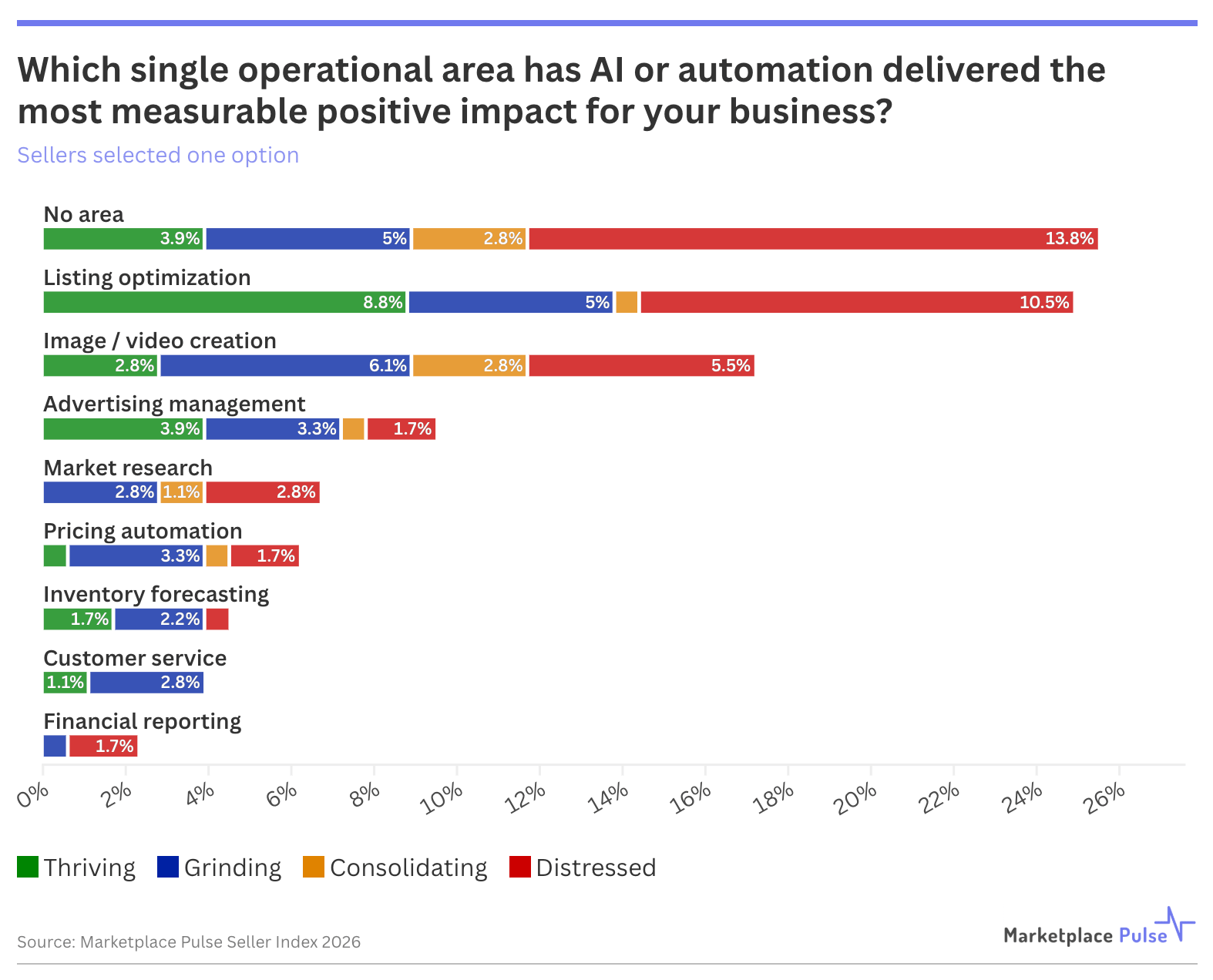
Sellers have adopted AI broadly but narrowly, putting it to work overwhelmingly on content tasks like listings and imagery, while platforms rebuild discovery around AI and consumers adopt it faster than expected. According to the Marketplace Pulse 2026 Seller Index, a survey of marketplace sellers representing over $2 billion in combined annual revenue, 83.4% now use AI somewhere in their operations, averaging 3.2 use cases each. Yet the single largest response on impact was that no area has delivered measurable results yet: 25.4%, ahead of any specific win.
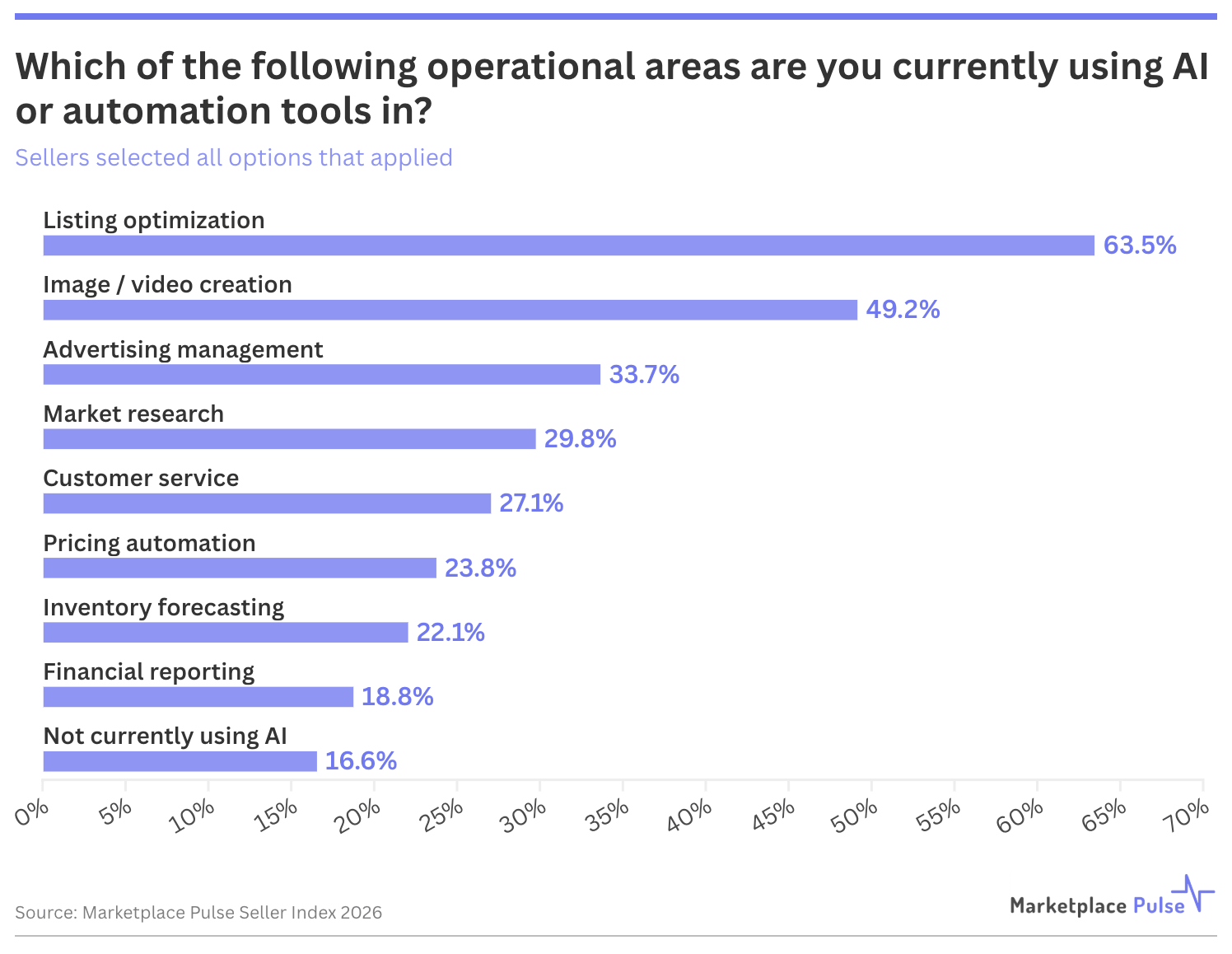
Adoption concentrates where AI feels most like a content tool. Listing optimization (63.5%) and image and video creation (49.2%) dominate; advertising management, competitive intelligence, pricing, and inventory forecasting sit well behind. Usage scales cleanly with revenue, from 2.42 use cases on average for sellers under $500K to 3.67 for those over $5M. But the null-impact response barely varies across revenue bands. Scale is bringing breadth, not better outcomes, at least not yet.
The clearer split emerges by seller health. Among thriving (revenue and margins up) and grinding (revenue up, margins flat or down) cohorts, roughly 16% report no measurable AI impact. Among consolidating (revenue flat or down, margins up) and distressed (both down) sellers, that figure is roughly double. Whether AI is contributing to the growth, or growing sellers have more capacity to extract value from it, is an open question that the current data cannot resolve.
Consumers aren’t waiting. Adobe Digital Insights reported a 393% year-over-year increase in AI retail traffic in Q1 2026. AI-referred visitors now convert 42% more than non-AI traffic, reversed from roughly half the rate a year earlier. Revenue per AI visit runs 37% higher than non-AI; a year earlier, non-AI visits were worth 128% more. Amazon CEO Andy Jassy credited the company’s AI shopping assistant Rufus with $12 billion in incremental sales in its 2025 results.
Infrastructure is moving just as fast, albeit not smoothly. OpenAI pulled its Instant Checkout feature as it refocused on core initiatives. Separately, Walmart reported that in-chat purchases converted at a third of the rate compared to when users clicked through to its website, a result that runs counter to Adobe’s aggregate numbers yet shows how quickly the picture is turning. Walmart is now embedding its Sparky chatbot inside ChatGPT, with Gemini next. Amazon continues extending agentic seller tooling, while Shopify has rolled out Shopify Magic for general merchants and a developer-focused AI Toolkit.
Against that flurry, the capabilities available to sellers are expanding quickly. The leading edge is already moving beyond prompting ChatGPT for ad copy, with some nine-figure sellers attending Marketplace Pulse events describing how they are building proprietary internal tooling that extends AI into territory the Seller Index has not yet captured.
In 2023, Marketplace Pulse wrote that AI would not be a differentiator but a new foundational level. On the platform and consumer sides, that has arrived; on the seller side, it’s still emerging. Most sellers still describe AI as a tool that writes bullet points. It’s increasingly becoming the operating layer and the channel itself.


