

Walmart’s advertising business grew more than twice as fast as Amazon’s last year. Amazon generated $68.6 billion in advertising revenue in 2025, growing 22%. Walmart generated $6.4 billion, growing 46%. The dollar gap is closing — from roughly 15:1 four years ago to 11:1 today — but remains large in absolute terms. Measured against each platform’s own e-commerce base, however, a different picture emerges.
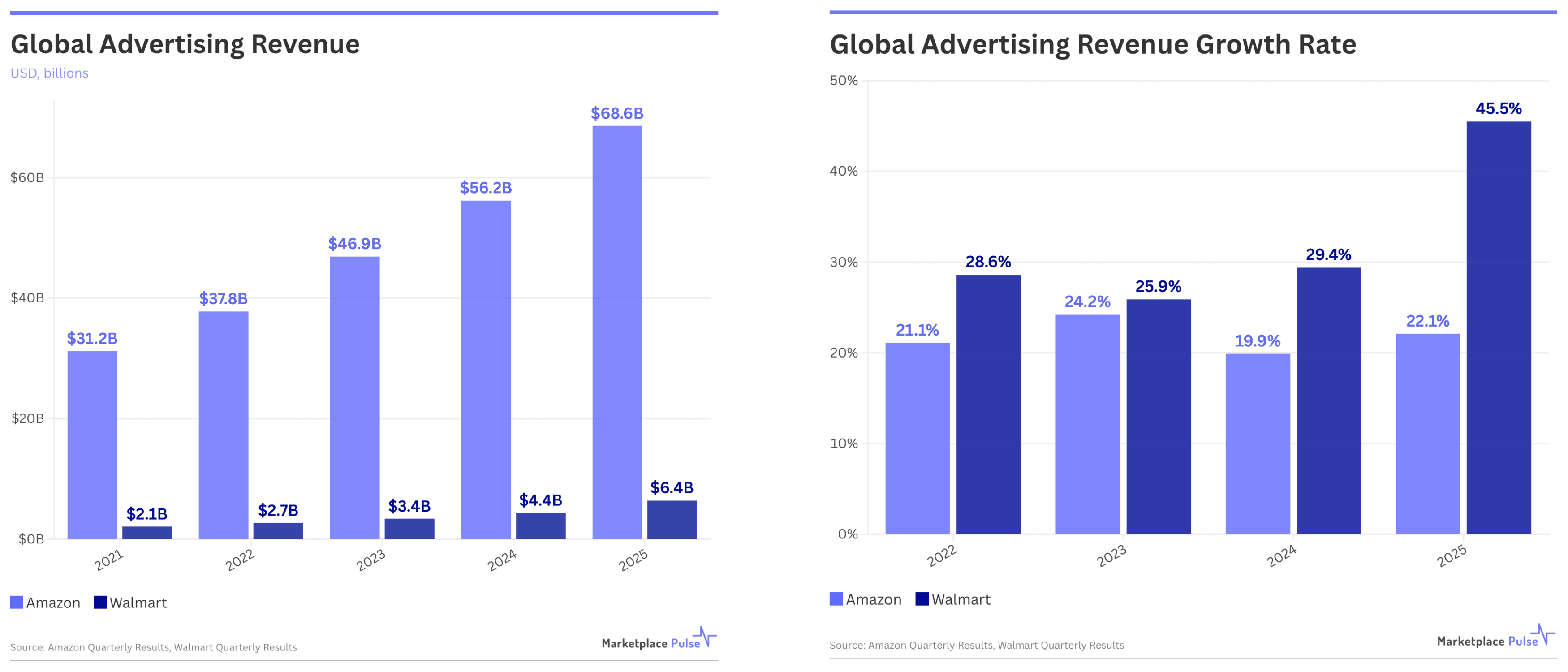
The $6.4 billion figure carries a caveat. It reflects Walmart’s global advertising metric, which includes VIZIO — the connected TV manufacturer acquired in late 2024 — whose ad network operates outside the retail media environment where sellers compete for visibility. Walmart does not break out VIZIO’s contribution separately. On its recent earnings call, CFO John David Rainey noted “triple digit growth” for VIZIO advertising from what remains a relatively small base. Walmart Connect, the US platform where sellers bid for search placement, grew 41% in Q4 and is the figure that matters for sellers. The VIZIO acquisition inflated the FY26 growth rate (Walmart’s fiscal year ends January 31) because it added a new revenue stream mid-year; from FY27 onward, comparisons will be like-for-like.
The dollar comparison also understates Walmart’s position when measured against its own e-commerce base. Global e-commerce exceeded $150 billion for the first time in FY26 — a figure Rainey disclosed on the earnings call but absent from the headline results. Amazon’s advertising represents roughly 8% of its estimated $830 billion GMV. Walmart’s $6.4 billion against a $150 billion e-commerce base implies penetration of around 4% — closer to 2:1 than 11:1 when measured this way. That gap also defines Walmart’s own ceiling. As Rainey noted on the call: “if you measure us advertising as a percent of the addressable market or our GMV, we still have a long ways to go to get in the neighborhood of some of the best-in-class competitors.”
The e-commerce profitability arc is what makes that runway credible. Walmart’s US e-commerce operation was losing more than $1 billion annually as recently as 2019. In FY26, it was profitable in every single quarter, with Rainey noting double-digit incremental margins. Advertising is the mechanism that made that turn possible — full-year advertising of $6.4 billion, three times its 2021 level, equalled over a fifth of Walmart’s $29.8 billion operating income.
For sellers, the most useful context is how early Walmart’s marketplace actually is. Marketplace GMV is estimated at around $15 billion today — roughly 10% of Walmart’s $150 billion e-commerce base, compared to an estimated 69% at Amazon. Advertising costs on Walmart are rising, and that trajectory is now established. But the same growth driving those costs is also building the scale, profitability, and competitive pressure on Amazon that makes Walmart an increasingly compelling place to sell.


