

Amazon collected $66.1 billion from seller fees and advertising in the third quarter, equal to 96.6% of the $68.5 billion it made selling goods online itself. A year earlier, that figure was 89.3%. Prime Day moved out of the third quarter this year, which flatters the comparison, yet across the second and third quarters combined, the gap still halved from $12.7 billion to $6.2 billion. Amazon’s original business is close to being overtaken by what it charges sellers and advertisers.
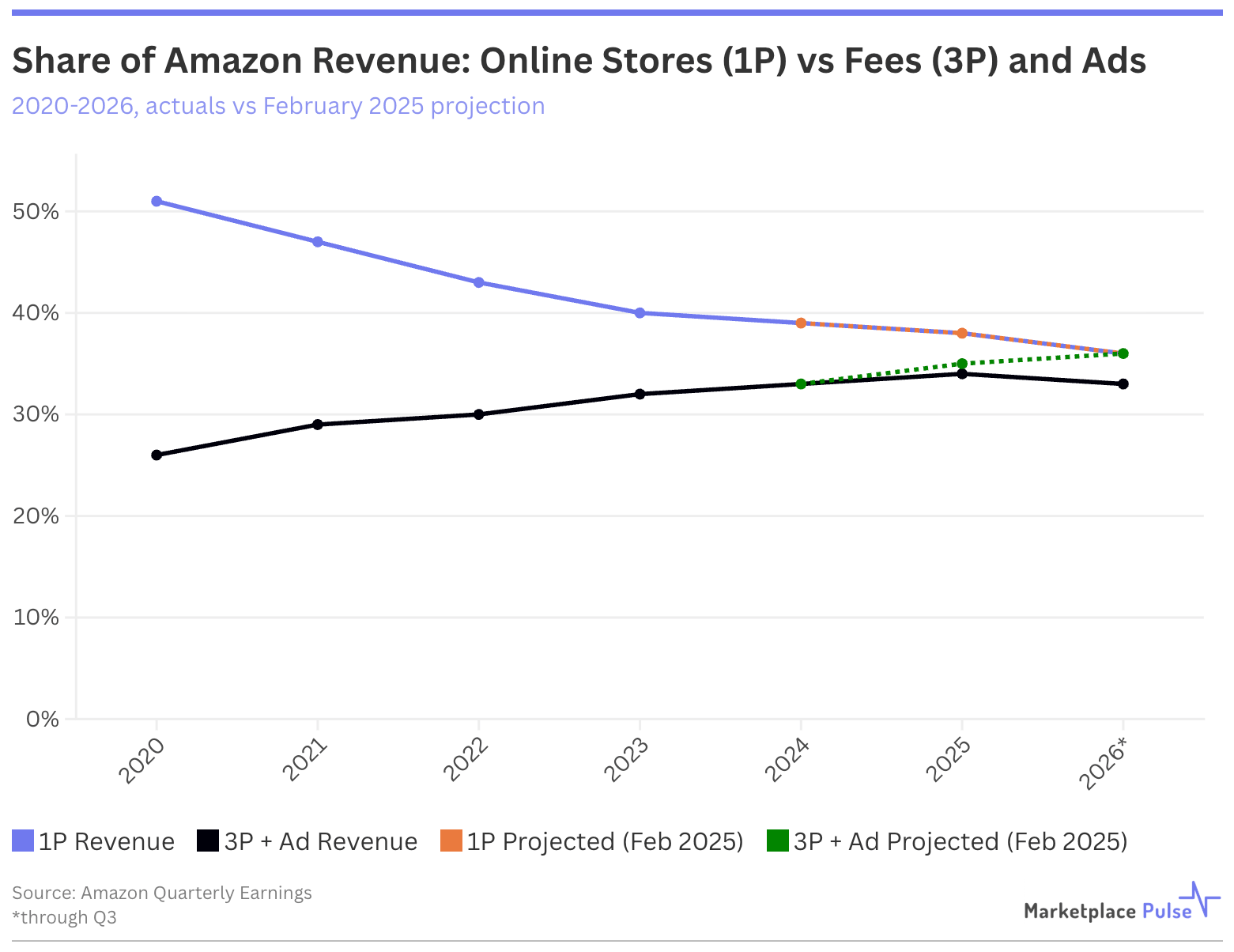
It is the near completion of a transition years in the making. Online and physical retail were half of Amazon’s revenue in 2021 and just over 40% a year ago. Over the past twelve months, they were 38.8%. Online stores alone were projected to meet fees and advertising at 36% of revenue this year. Retail is on track at 35.9%. Fees and advertising are not, holding at 33.3%, the same as in 2024. Their revenue is up 25% since then, nearly ten points more than online stores, but that only matched Amazon overall, because AWS grew 50% and took the share instead, rising from 16.9% to 20.2%. That is the same transition from a different direction: another infrastructure business replacing the one that sells goods.
The unit numbers might suggest that Amazon is drifting back toward retail, but the revenue balances the outlook. Its retail arm has won back share of units from sellers, as groceries, largely fulfilled through Amazon’s own network, showed up in its own unit count. Even so, what Amazon charges others is growing nearly twice as fast as what it sells itself. For sellers, that changes what Amazon is to them. Its retail arm still competes with them for the sale, but sellers are increasingly Amazon’s customers, buying access to its shoppers, fulfillment network, and advertising.
On the twelve-month numbers, the lines would meet around spring 2028, later than projected, and the holiday quarter will reopen the gap first because it favors retail. The direction is unlikely to change, and that makes it worth knowing exactly what the access costs. Amazon’s fees pay for demand and logistics that sellers would otherwise have to find elsewhere, and every other route to a customer charges for the same things in a different form. Walmart’s advertising is growing faster than its sales, TikTok Shop sellers pay creators a commission on each sale, and direct-to-consumer brands pay Meta for traffic. A headline rate says little about any of them. The number that matters is contribution margin by channel: what remains of a sale once fees, advertising, and fulfillment are paid. Sellers who can see it clearly can decide where the next dollar of inventory and advertising should go, on Amazon and off it.


